 Worm gear drives are a type of shaft gear assembly capable of transmitting power between a non-intersecting drive (input) shaft and a driven (output) shaft, generally used when the two axes of rotations are at 90° angles to each other.
Worm Drive Components
Worm drive assemblies consist of a worm, which rotates with the driving shaft and looks a bit like a threaded screw. A worm gear (or wheel) meshes with the worm, which transmits the rotation of the input shaft to the output shaft on which it is attached.
So, in a worm drive gear assembly, the worm is the driving shaft and the worm wheel - a large diameter helical-type gear situated perpendicularly to the worm - is the driven shaft. The worm wheel will often have angled teeth to match the angle of the worm threads attached to the input shaft for best mechanical performance. The angle of these teeth is often referred to as the helix angle.
Worm gears can be either left or right-hand threaded, which refers to the direction of the gear’s teeth.
Worm Drive Assembly Uses
Worm gear assemblies significantly reduce speed between the driving shaft (the worm) and the driven shaft (the worm wheel). In practice, this can be useful when a large amount of torque is required out of the output shaft, or speed reduction is required in a tight space.
Applications
 Commonly-known applications of worm gears include tuning pegs on stringed instruments like violins or guitars, or hoists like you might find on a boat trailer. In both scenarios significant amounts of torque output is needed and back-driving the gear is undesirable.
Worm gears are found in many industrial applications, including:
- Conveyor systems
- Elevators & lifts
- Machine presses
- Four wheel drive vehicles
How Worm Gear Drive Assemblies Reduce Speed & Increase Torque
Typically a worm gear’s threading is considered the equivalent of a single gear tooth. With each full rotation of the driving shaft, the worm’s threads shift over a single pitch distance (or tooth’s width) along a linear plane.
This movement drags the meshed gear exactly the pitch distance of one of its teeth, meaning the driving worm gear will have to rotate the same amount of times as the number of teeth on the meshed driven gear to output a single rotation of the driven gear. This high gear ratio reduces speed but also increases torque.
Finding Worm Gear Ratios
Gear ratio is the tooth count of the output gear divided by the tooth count of the input gear. Since a worm gear is considered to have a single threaded tooth, one rotation of the worm will move the worm wheel a distance of a single tooth. A basic worm drive assembly’s gear ratio will be determined this way:
Worm Wheel Teeth (x) / Worm Teeth (1)
However, some worms are threaded in a way to produce more than a single tooth’s width per rotation of the worm. Examples of these are double and four-thread worms, which will generate movement on the driven wheel of two or four teeth’s width per rotation of the worm, respectively.
In all scenarios, the output shaft (containing the worm wheel) will lag behind the number of rotations of the input shaft (the worm). Worm gear efficiency can range from 98% for the lowest ratios to 20% for the highest ratios.
Advantages
Due to the high gear ratios produced by the worm’s threads along the worm wheel’s teeth, a worm gear assembly is a very efficient configuration for creating torque in driven shafts. With relatively little energy loss, the rotation of the drive can generate large amounts of torque for the output shaft.
The consistent sliding action of the worm gear’s threads along the face of the driven worm wheel creates very little vibration and low noise. The nature of this sliding also makes the worm gear assembly essentially backlash resistant, so only the worm can drive the worm wheel, never the other way around. If the worm gear is forced to move in the opposite direction of the worm, the entire assembly will seize up.
Disadvantages
The ability to create torque in the output gear comes at the expense of transmission efficiency, since it takes so many rotations of the worm’s threads to move the worm wheel. The sliding contact between the worm gear and the teeth of the worm wheel produces axial thrust force which generates additional friction, giving it the disadvantage of high heat retention. Because of this, proper lubrication and consideration of the types of bearings used is required.
Worm Drive Types
 Worm drive assemblies mesh a worm drive with a worm wheel. The manufacturing methods and different pairings of these two main components impact the overall performance of a worm gear assembly.
The worm is the driving component of a worm drive assembly. There are two main types of worms used on input shafts of worm gear assemblies: cylindrical or concave, each offering different working characteristics and uses.
Cylindrical Worm Drives
Cylindrical worm gears are the most common type, with the simplest mechanical function. They are used in general applications where moderate load capacity is expected and moderate efficiency is required.
Cylindrical worm drive characteristics include:
- General purpose use
- Moderate efficiency & load bearing capacity
- Found in a wide range of industrial machinery
Single-Throated Worm Drives
In contrast with a cylindrical worm in which the sides of the worm are parallel, single-throated worm drives have concave tooth profiles which help “grab” the teeth of the meshed worm wheel. In a single-throated worm drive configuration, the concave worm is paired with a straight faced worm gear.
Single-throated worm drive characteristics include:
- Improved contact area compared to cylindrical worm drives
- Higher efficiency & load distribution
- Commonly found in more precise industrial applications like actuators or lifting systems
Double-Throated Worm Drives
Sometimes called cone, double-enveloping worms or drum-shaped worm gears, these types require high precision in order to configure properly. Due to the concave shape of the worm and the convex shape of the wheel’s face, these types of worm drive assemblies offer the highest contact ratios per rotation of the driving shaft with the driven worm wheel.
Double-throated worm drive characteristics include:
- Contoured worm drive & worm wheel pairings
- Highest contact area with best efficiency & load capacity
- Used in heavy-duty applications like industrial presses & high-precision machine tooling
Worm Wheel Types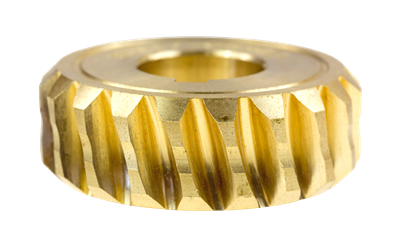
The worm wheel is the driven component of a worm drive assembly. There are three main types of worm wheels in a worm gear assembly, with differences in machining processes and capabilities.
Milled Straight-Face Worm Gear
The most basic type of worm gear, these are essentially standard spur gears, possessing a helix angle of 0° and are produced using a less precise milling process. Because of this, the point of contact between the worm and a straight-faced worm gear is limited, making them best suited for light duty only.
Hobbed Straight-Face Worm Gear
A hobbed straight faced gear offers more precision than a standard straight-faced worm gear, because the gear teeth are cut using a high-precision hobbing process which provides improved wear resistance and highly precise and consistent tooth spacing.
Convex Face Worm Gear
A convex worm gear is cut with a rounded tooth profile. When paired with a concave worm drive, the meshed components create a double-throated worm drive, which offers the highest contact ratio between the two parts. This allows for more efficient power transmission and higher gear precision with elevated load capacity.
Worm & Worm Wheel Materials
In worm drive assemblies, the worm is typically made of harder material than the worm wheel with which it meshes. For example, a worm may be made with carbon steel or a steel alloy, while the driven worm wheel may be made of softer materials like bronze, cast iron, aluminum or even nylon. Bronze or brass is often the material of choice in hobbed worm wheels.
Worm Gear Lubricants
Since the meshing of the worm and worm wheel in a worm gear assembly includes a sliding force that produces significant axial thrust, lubricants involved will rub nearly completely off by the time the threaded worm comes out of contact with the meshed worm wheel’s teeth. Lubricant is re-applied by the time the worm’s threading comes into contact with the next tooth on the worm wheel.
The sliding motion requires a lubricant with higher viscosity than what is usually needed for the same load in a standard rolling wear scenario. If you’re unsure of the appropriate lubricant for your worm drive assembly, the engineers at WM Berg can help.
Expert Guidance for Worm Gear Design
Our team of experts is ready to guide you through design, configuration and troubleshooting worm drive assembly components to maximize your industrial application’s performance.
Contact our team of experts for guidance on worm gears or with general questions on drive systems for industrial application.